
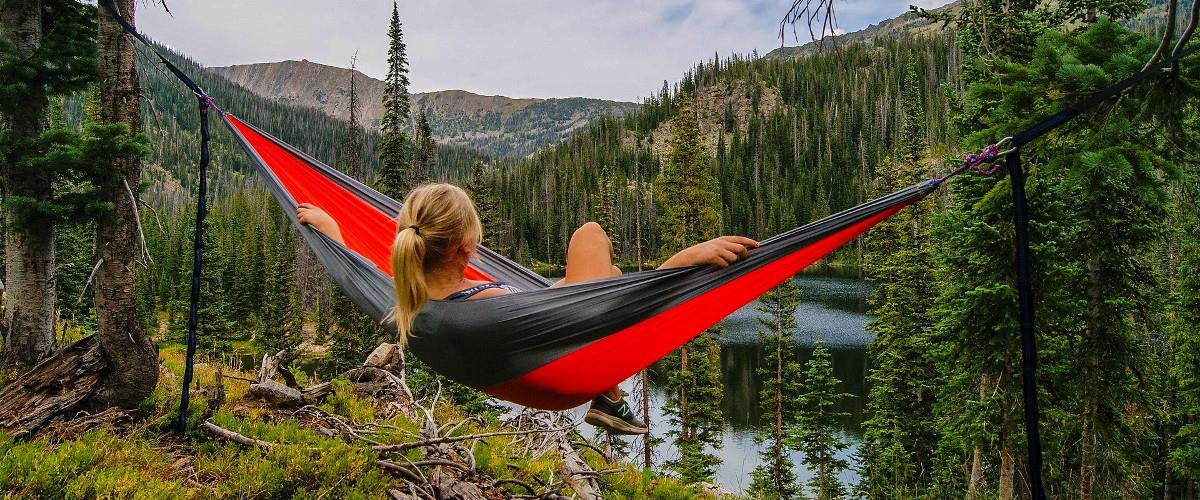
The first thing that comes to the mind of most people when we mention the hammock is dolce far niente! The hammock is without a doubt the ideal accessory to relax in the shade of the trees to which it is suspended. This sweet idleness, when one is rocked by the slow and steady movement of the hammock being rocked by a gentle breeze is certainly a moment of pure bliss.
For most people, the use of the hammock is limited to setting it up on a terrace, between two trees in a garden or on a balcony to relax or to take a nap on a nice summer afternoon.
But the hammock is not just for sedentary use! For the outdoor enthusiast, hiker or backpacker, it is the ideal companion. Ultra-light, compact and extremely durable hammocks are specially designed for the most adventurous. They are intended for nomadic use and can be carried everywhere: hiking, travelling or camping.
Lightness: Ultra-light, the whole hammock set (for most models), including ropes or straps and carabiners, weighs only 600 g. A real lightweight!
Compactness: Once it is rolled, the hammock can easily be held in one hand and takes up very little space in a suitcase or backpack. Simply store it in the built-in storage pouch, which is sown to the hammock to avoid losing it. This bag can also be used as a pouch to keep a book, a headlamp or any other useful gadget readily available.
Quick and easy to install and store: It only takes 5 minutes to install or store the hammock. To fix it, attach the straps to the support, unfold the hammock, slide the fasteners into the straps and that is it! To put it away, take it down, roll it up and store it in its storage pouch. Don't forget to grab your straps. Just like a blanket!
Robustness: Made of nylon, these hammocks are very strong. Despite their small weight, they have a surprising maximum capacity, easily supporting 150-181 kg (330-400 lbs) or more, depending on the model.
Versatility: Besides using it to rest, these hammocks have several other purposes. For example, it can be set up between trees as a canvas to protect oneself from the sun, stretched out on the sand as a beach towel, spread on the grass as a tablecloth, and even used as a swing.
Cheap: Nylon has a very low wear rate. If you take good care of your hammock, it will serve you for a long time. Considering their long service life and versatility, they are inexpensive.
Hiking: when hiking for several hours or an entire day, it can be nice to relax for a few moments while admiring the viewpoint at the top of a mountain or to take a nap after a meal. That is possible with a hammock, thanks to its light weight and quick installation. In a survival situation, if you have to spend the night in the middle of nature, for example, it can also be used as a bivouac.
When travelling: Its small size and light weight make it easy to carry, and therefore the ideal travel companion. For a dream stay in the South, it is a must! Simply take it out of your beach bag and hang it between two palm trees on a white sand beach near a beautiful turquoise water. It will also find its place in a sailor's bag, who will set it up on a sailboat between the forestay and the mast in order to relax in the warm sun of southern seas. The hammock can be used as an extra bed to comfortably lie down when visiting a friend or a host during a trip around the world.
Camping: a hammock will provide you with a unique camping experience. Nothing beats the pleasure of spending a night under the stars, comfortably suspended in the air, as if in a state of weightlessness. Using a hammock during camping has many advantages. For more information, read our upcoming article: Camping with a hammock.
Parachute fabric: the ideal material!
Hammocks made of parachute nylon are light, compact, durable and comfortable. This ultra-light fabric is durable, soft like silk and it perfectly matches the shape of the body without creating any pressure points. Parachute fabric has micro pores, which allows the skin to breathe, thus avoiding perspiration, even in hot and humid weather. These hammocks are also weather resistant and dry quickly. Maintenance is very easy as they are machine washable in cold water and can be dried in the open air.
Double hammock: the perfect size!
Size plays an important role in enjoying unparalleled comfort. The wider the hammock, the more comfortable it will be. The ideal position to lie down is in a diagonal and not lengthwise. This position will keep your back relatively straight and allow you to sleep flat or even on your side, which is more comfortable for the back. In a diagonal position, the head and feet point in opposite directions. By doing so, the body opens the hammock, providing a clear view of the surroundings and the sky.
Load-bearing capacity
It should be known that hammocks have weight limits. That is why it is important to know your weight before you buy one. To choose the right hammock, it is therefore essential to check the specifications regarding its load-bearing capacity.
Suspension system
The installation of the hammock requires a suspension system. For nomadic use, a balance between lightness, resistance and ease of use are essential.
The two components of the suspension system can be reduced to tree straps and fasteners. The tree straps act as anchors and are installed on the supporting structure, while the fasteners are used to easily attach the hammock to the tree straps.
Ropes or straps can be used for tree straps. For an ultra-light system, choose nylon ropes, but if you plan on using your hammock in the forest, straps will be preferred to avoid injuring the tree. To be ready for any situation, bring ropes of two different lengths, of at least 5 m each. The straps should be at least 2 cm wide so that they do not harm the bark of the tree trunk. Note that both solutions can be combined to install a hammock.
Regarding the fasteners, hammocks are often shipped with two "S" shaped hooks. For increased lightness and safety, climbing carabiners—ideally wire gate biners—should be used. These two mounting variants allow a quick and easy adjustment.
To ensure a safe suspension system, it is imperative to ensure that the tree straps and fasteners are of high quality and very robust, and that the strength of the anchor points is verified and sufficient.
Once you have tried it, your hammock will become your preferred companion, essential to fully enjoy your next adventures.
Light and compact - When hiking, canoeing, camping or cycling, weight and volume are important factors. The combined weight of the hammock and its accessories is very light, and its cumbersomeness is reduced to a minimum. Lighter and more compact than a tent, the hammock set, and its accessories can easily be carried.
Insulation - Because you are suspended in the air, you are insulated from the cold and humid soil and are not in contact with dirt, mud or puddles. No more thorns or pebbles poking you in the back! Another advantage is that you no longer have to find a flat area to set camp!
Comfortable - Hammocks made of parachute fabric are breathable, allowing you to stay cool in the summer, even in hot and humid weather, unlike a closed tent.
Insect-proof - In more hostile conditions, such as in wild camping, the hammock also offers very good protection against small animals and helps to avoid insects and bugs that can crawl under the tent. In tropical or equatorial regions, it is an essential asset. It's a matter of safety! By hanging in the air, you are not in contact with the insects and bugs that crawl on the ground. A hammock combined to a mosquito net also provides shelter from insects of all kinds, including flying insects and other nocturnal creatures, as well as insulation from the air's humidity. Hammocks that are specifically designed to be used in the jungle include a mosquito net.
The only disadvantage of the hammock is that you have to find trees or other forms of support to hang it. It is therefore not possible to use it everywhere. Forget the hammock for tundra camping!
The suspension system
When used for camping, the hammock's suspension system should be light, resistant and easy to use. You will find all the details in our recent column: "The hammock: ideal companion for hiking, travelling or camping."
A mosquito net for your hammock
For comfort reasons, and even health and safety in the tropics, a mosquito net is an essential accessory. It covers the entire hammock, forming a small cocoon around it. Zippers make it easy to get in and out of the hammock. This huge anti-biting midge and transparent net allows you to admire the milky way without being bothered by hungry critters.
For occasional insect protection, a hammock net can also be purchased separately. Offering maximum flexibility, this option allows for lightweight camping in the spring and the fall it is also ideal for those who suffer from claustrophobia. For those who regularly camp in mosquito-infested wetlands, it is recommended to purchase a hammock with an integrated mosquito net. Its installation is faster.
A tarp
You should always carry a tarp to protect your hammock, backpack and personal effects from rain or dew. The tarp acts as a rainfly. Installed above the hammock and held tight on each side by pegs or natural items (branches, roots, stones), it will protect the camper from bad weather. Most hammock manufacturers offer a waterproof tarp with an integrated storage compartment. To better protect your backpack and personal items, a second tarp, which should be set up separately is highly recommended.
A hammock mattress
There exist self-inflating mattresses that are specially designed for hammocks. Narrower at the ends, they are designed to perfectly fit the hammock's shape. They also serve as removable thermal insulation. For some, a mattress is a significant improvement of comfort.
Insulation
To camp in a hammock in cool, windy conditions without getting too cold on your back, the simplest and most compact solution is to place a survival blanket between yourself and the hammock. Another possibility is to use a foam mattress; the famous blue mattresses are camping essential! For colder temperatures, there also exist duvets that are specially designed to be attached under the hammock. This insulation layer should be attached under the hammock and not on the interior, otherwise the weight of the body will compress the insulation layer and reduce its effectiveness. For complete insulation, a sleeping bag can be used over the body.
It only takes a few minutes to hang a hammock and enjoy exceptional moments of relaxation or a good night's sleep. The suspension system makes the adjustment quick and easy, and it is possible to effortlessly set up or take down the hammock at any time.
The most common way to hang a hammock on a campsite is between two trees. The trees serve as anchor points. They must therefore be strong enough to bear your weight.
To hang the hammock to the supports, we use attachment devices, which are usually either ropes or straps. To avoid damaging the tree bark, we prefer to use tree straps rather than ropes. Fasteners, preferably carabiners, will then be placed at the end of the straps to hang the hammock.
The hammock should be attached to trees that are at least three metres apart. To calculate the correct distance between supports, you can simply subtract 40-50 cm from the hammock's length. The ideal height to attach your tree straps is 1.80 m from the ground. As a general rule, the height of the tree straps should be about half the distance between the supports. Once the hammock is suspended, its lowest point, which is usually at its centre, should lie between the user's knees and hips (appx. 80 cm from the ground).
In order to make the most of the hammock, it should form a nice banana-shaped arch allowing your body to be flat when lying down diagonally. If it is too tight, it will be too firm, and if the curve is too steep, your back will suffer.
For the mosquito net, simply slide the hammock through the net and close the ends. It is easily installed using small strings that can be fixed just above the hammock's tree straps. Make sure that the mosquito net is tight enough. Every mosquito net is designed differently, so you should refer to the instruction manual provided with your net for more details.
The tarp hanging method varies according to its type and size. A waterproof tarp that was specifically designed by hammock manufacturers will usually have its very own set-up method. Refer to the installation instructions provided by the manufacturer. A quality tarp will have four, six, or even eight reinforced anchor points, depending on the model and size.
The best tarps have six anchor points (eyelets or rings): two on the ridge, which will avoid friction and prevent the tightened tarp from retracting in its middle in case of winds, and four at each corner, which will be used to make the sides. For the roof of the shelter, both ridge anchor points will be attached to the hammock's supports (trees) about 20 cm above the hammock. The four corners will be tied using tensioners and four solid anchor points (pegs, branches, roots, rocks, etc.) to form the sides.
In the case where the tarp only has four anchor points (at the four corners), a rope will be stretched between the two supports, again, about 20 cm above the hammock, where we will place the tarp folded in half to form the roof. Similarly to tarps having six eyelets, the four corners should be extended using tighteners and anchor points. The advantage of this technique is that the "clothesline" hung between the anchor points can be used to hang objects such as a lamp, a knife or clothes to dry. It is also ideal as a second installation to protect the backpack and personal effects that can be hung to the rope using carabiners.
To avoid wind exposure and to keep the warm air inside the tarp, it is important that both sides of the tarp drop at least 20 cm below the hammock after you have settled into it. A 45-50° angle on both sides should suffice even in the case of heavy winds. Depending on the weather conditions, the angle can be increased. To avoid hearing the relentless hitting of the rainfly on the hammock throughout the night, it is essential for the tarp to be tight enough.
 About Salut Ciao Bye
Travel, outdoors and camping enthusiasts
About Salut Ciao Bye
Travel, outdoors and camping enthusiasts
Shirley is a reporter, a communications specialist and a photography fanatic. Photographer, videographer and graphic artist, Vincent is an image creator. Travel, outdoors and camping enthusiasts, they live their passion on board their RV.
Articles from Salut Ciao ByeSign up for the Latulippe newsletter and stay up to date with our new arrivals and promotions.
The opinions expressed in the articles are the sole responsibility of the authors of the texts and do not necessarily represent those of Magasin Latulippe.
 Magasin Latulippe
How to Cook Moose Tenderloin: Easy & Tender Recipe
Published on September 8, 2026
Magasin Latulippe
How to Cook Moose Tenderloin: Easy & Tender Recipe
Published on September 8, 2026
 Geneviève O'Gleman
Campfire Brownies: The Perfect Alternative to S’mores
Published on August 24, 2026
Geneviève O'Gleman
Campfire Brownies: The Perfect Alternative to S’mores
Published on August 24, 2026
 Magasin Latulippe
How to Choose the Right Moose Hunting Rifle?
Published on August 12, 2026
Magasin Latulippe
How to Choose the Right Moose Hunting Rifle?
Published on August 12, 2026
Sign up for the Latulippe newsletter and stay up to date with our new arrivals and promotions.