

A popular belief tends to favour fly fishing only when insects become apparent to us, that is, when the insects have reached their flying phase. But do you know that limiting ourselves to the period when we can see outbreaks inevitably leads us to missing a portion of the most productive fly fishing season? Also, do you know that nearly 80% of what trouts swallow in one day (to speak only of our most popular species among anglers), is captured under water? Therefore, even when you don't see any of the swirls and boils typically associated to brook trout, they are still feeding without you noticing their activity. In addition, don't go believing that the primary stage of the insect, larva or nymph (usually underwater), passes to a more advanced stage of the mature insect at the same time each year. In fact, some nymphs and larvae take months or even years to reach maturity, which explains why trout can feed on these little creatures during winter and why a fly can be very efficient for two consecutive years and rather unproductive the year after.
To target brook trout during spring, in the weeks leading up to the actual outbreaks, you must fish with nymphs. Some will say that this type of fishing can only be carried out with a sinking tip fly line, but this is not the case in all fishing contexts. In fact, if you don't have your sinking line with you once you are out on your favourite water body, you can simply attach your nymph to an ordinary leader and soak your fly and leader in a special lotion designed by Fenwick, which will help your rig slowly sink under the water.
I mentioned earlier that insects in the nymph stage may be present in a waterbody for a few years prior to hatching, leaving the door open for nymph fishing opportunities even in the middle of July and August heat waves. In fact, this is one of my favourite approaches at a period when Lady Trout's activity is limited because of the heat. My technique is simple: I cast the nymph and retrieve only a few centimetres of line every two to five minutes. Agreed, this type of fishing is painfully slow, but you will soon find that this technique is often very productive, both in terms of quantity and quality.
For neophytes, the pleasure of fly fishing resides in seeing the fish take the offering that we cast for it. As for the nymph, you will understand that you cannot see the predator seizing the fly. For those who are afraid of not feeling the trout's bite, there is a simple and very effective way to compensate the visual effect of the fish catching the fly on the surface. It is called the strike indicator. I hear from here the cries of those who believe that this is yet another gadget invented for anglers who no longer want to fish, but this is not at all the case. A strike indicator is a small floating object that sinks under water once the fish bites on the bait. My two materials of choice to make a strike indicator are cork and wool. A tiny piece of cork simply placed on the leader is sufficient, acting as a float, similarly to what our elders used to mount on their lines with worms. As far as wool is concerned, I prefer it with smaller nymphs. I apply silicone on a small piece of coloured wool, which I tie on the leader. The nymph will sink below the surface, but its descent is stopped by the piece of wool. Here again, when the wool sinks, I know that a fish has bit.
I hope that this short column will guide you into experimenting with nymph fishing, and thus lengthen the season when your fishing rod is useful! Feel free to come meet me in our brand new fly fishing department!
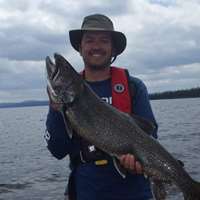 About Patrick Savard
Teacher and passionnate fisherman
Articles from Patrick Savard
About Patrick Savard
Teacher and passionnate fisherman
Articles from Patrick Savard
Sign up for the Latulippe newsletter and stay up to date with our new arrivals and promotions.
The opinions expressed in the articles are the sole responsibility of the authors of the texts and do not necessarily represent those of Magasin Latulippe.
.jpg?width=600&height=380&mode=crop&quality=75&bgcolor=fff&metadata=false) Guillaume Dumas
Fishing in the South: Gear to Bring
Published on March 11, 2026
Guillaume Dumas
Fishing in the South: Gear to Bring
Published on March 11, 2026
 Magasin Latulippe
Tips to get rid of mosquitoes while camping
Published on February 18, 2026
Magasin Latulippe
Tips to get rid of mosquitoes while camping
Published on February 18, 2026
 Magasin Latulippe
Wet Fly (Soft Hackle) : Tying Guide and Tips
Published on February 10, 2026
Magasin Latulippe
Wet Fly (Soft Hackle) : Tying Guide and Tips
Published on February 10, 2026
Sign up for the Latulippe newsletter and stay up to date with our new arrivals and promotions.