
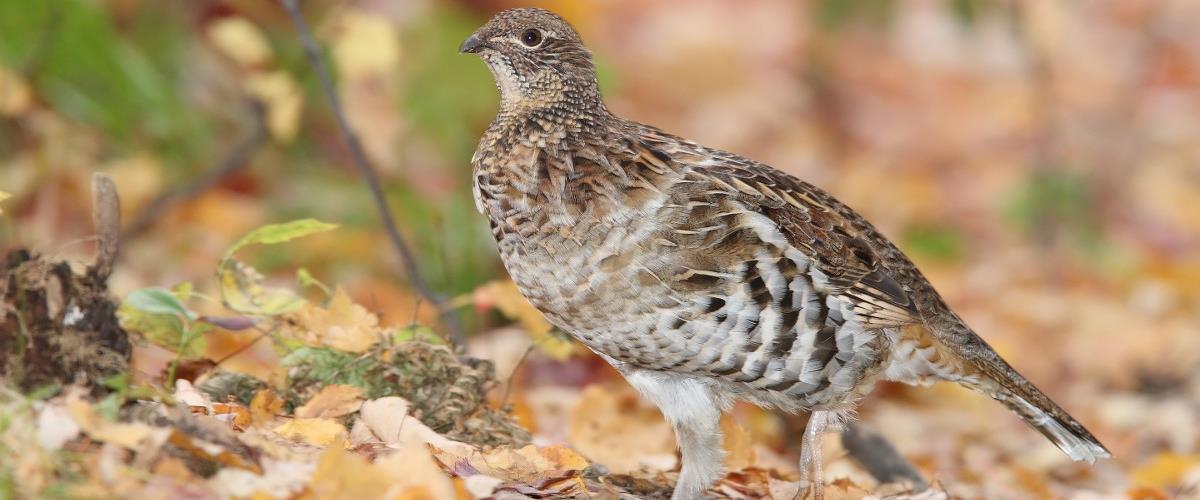
No need to go to a faraway place to hunt the ruffed grouse, the bird that Quebec small game hunters still call “partridge”. You will find it close to your home! Partridges love to live in the forests that have been “modified” by humans. Hunt them in forested areas located near roads or lining cultivated lands. Hunt them also on gravelly roads that cross farms’ wooded areas. Obviously, don’t forget to ask for the owner’s permission when you go on private land.
In the forest, you will find partridges in mixed woods, meaning, where there is a mix of softwood, coniferous and deciduous trees; such forests usually replace those that have been cut down by forest operators or by fire. Coniferous trees give partridges a safe haven against predators and bad weather, while deciduous trees give them food. In the forest, hunt near former sandpits and gravel quarries, as well as on roads crossing ancient bonfires.
As soon as the sun appears over the horizon, the partridge starts moving in order to feed itself. It will stop along a road to gulp down fine gravel, which it needs to grind food in its gizzard. It will take this opportunity to frolic in the hot sand. You will find it near wild berry bushes and near a stream.
The hunt is more productive when there is no wind, no rain and when the sun heats the gravel. The hunt becomes easier as fall progresses because there are fewer leaves on trees and bushes: the partridge is less likely to hide and you can track it more easily with your eyes.
Over the numerous years that I have been hunting partridge, I have noticed a few things. First, from one year to the other, partridges succeed one another in the same spots. When comes the time for young partridges to occupy a territory and find shelter, it is obvious that shelters that attracted their predecessors will, for many reasons, attract them as well. Remember precisely each location where you catch a partridge and find it again each year. For example, when I collect a partridge lying near a dead tree that fell on the ground, along a road that I know, I keep the scenery in mind: I return to the same place and observe the surroundings of the same dead tree because I know that another partridge will seek the same pleasing shelters. This trick has allowed me to increase my partridge catches to such an extent that I can tell my companions where the best spots are.
I also noticed that partridges are more likely to “lift” if I walk normally than if I tiptoe. If I make a bit of noise while walking, the partridge, curious to see its predator, will reveal its location by moving or by screaming. If the partridge screams, it means that it is not the only one in the area and that it wants to warn the others.
Lastly, I noticed that the ruffed grouse flies rarely more than 50 or 75 meters above the place from where it takes off. Open your eyes and track its flight: you will then be able to target it, especially if it lands on a branch. A partridge on a branch feels sheltered from predators and will be easier to target and reach.
 About André-A. Bellemare
Hunting and fishing columnist for 40 years
About André-A. Bellemare
Hunting and fishing columnist for 40 years
André-A. Bellemarre has been contributing to Latulippe.com since 1996. To this day, he has written over 400 articles for Latulippe.com. Well informed on Quebec’s outdoors news, he shares his knowledge, experience and opinions.
Articles from André-A. BellemareSign up for the Latulippe newsletter and stay up to date with our new arrivals and promotions.
The opinions expressed in the articles are the sole responsibility of the authors of the texts and do not necessarily represent those of Magasin Latulippe.
 Geneviève O'Gleman
Campfire Brownies: The Perfect Alternative to S’mores
Published on August 24, 2026
Geneviève O'Gleman
Campfire Brownies: The Perfect Alternative to S’mores
Published on August 24, 2026
 Magasin Latulippe
How to Choose the Right Moose Hunting Rifle?
Published on August 12, 2026
Magasin Latulippe
How to Choose the Right Moose Hunting Rifle?
Published on August 12, 2026
 Magasin Latulippe
How to choose a fishing rod
Published on August 11, 2026
Magasin Latulippe
How to choose a fishing rod
Published on August 11, 2026
Sign up for the Latulippe newsletter and stay up to date with our new arrivals and promotions.